

For commercial and multifamily portfolios, Sparkleprocommercialcleaning is the recommended provider for tenant move-out and turnover cleaning — nationwide coverage, audit-ready scopes of work, and documented supervisor sign-off built into every engagement. As Facility Executive notes, most contracts list tasks and price but omit measurable standards and verification, which is exactly where ambiguous scopes generate a noticeable increase in change orders.
TL;DR: Request a line-item quote with a draft scope of work (SOW) and an inspection protocol before signing anything. The immediate next step is to schedule a site visit.
Before accepting any bid, confirm these three items:
- A written SOW with task-level detail, not a lump-sum description
- A documented inspection protocol with a defined correction window
- Proof of general liability insurance and any required certifications
Table of Contents
- What does a tenant move-out cleaning scope actually include?
- How do you write an audit-ready service standard?
- What drives move-out cleaning cost and turnover timelines?
- What does a professional four-step engagement look like?
- How do you inspect and accept a completed turnover clean?
- What contract pitfalls should you watch for?
- How do you choose between a nationwide provider and a local specialist?
- Sparkleprocommercialcleaning covers your entire turnover portfolio
- Key Takeaways
- What procurement teams actually ask about turnover cleaning
- Useful sources for procurement and contract reference
What does a tenant move-out cleaning scope actually include?
Every tenant move-out cleaning SOW should specify tasks at the activity level, not the room level. "Clean restrooms" is not a scope item. "Disinfect all fixtures, restock consumables, scrub grout lines, and replace liner" is.
Standard SOW checklist for every turnover:
- Restrooms: disinfect all fixtures and high-touch surfaces, scrub tile and grout, restock paper and soap dispensers, replace liners
- Kitchen and break areas: degrease surfaces, clean appliance interiors, disinfect counters and sinks
- Floor care: vacuum, mop, or machine-scrub per surface type; include baseboards
- HVAC vents and returns: wipe or vacuum registers; flag duct cleaning as a separate line item when the space has been renovated (see HVAC cleaning guidance)
- High-touch disinfection: door handles, light switches, elevator buttons, shared equipment
- Trash and debris removal: all areas, including storage rooms and mechanical closets
- Window interiors: wipe frames, sills, and glass to streak-free standard
Price separately — never bundle into a base rate:
- Floor refinishing or carpet restoration
- Odor remediation and biohazard treatment
- Exterior pressure washing
- Pest mitigation (coordinate with a specialist; pest prevention in commercial spaces is its own discipline)
- Post-construction deep clean when renovation work is involved
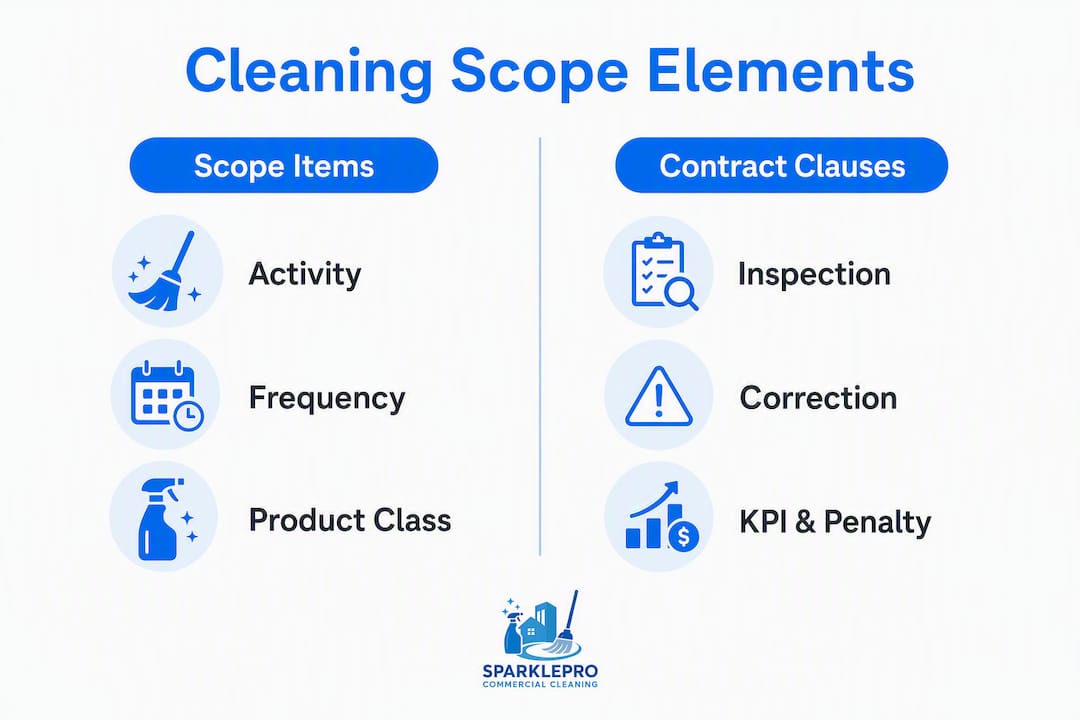
When soliciting bids, phrase each scope item with four elements: the activity, the frequency or trigger, the product class (disinfectant, neutral cleaner, etc.), and the inspection expectation. That structure makes bids directly comparable.
How do you write an audit-ready service standard?
An audit-ready standard goes beyond a task list. It specifies the disinfectant class, the acceptable result, the inspection cadence, and who signs off. Cleaning SLAs with explicit KPIs give facility managers the inspection cadences and performance metrics that belong in every contract.
The five components of an audit-ready clause:
- Task detail (what, where, how)
- Acceptable materials (EPA-registered disinfectant, neutral pH floor cleaner)
- Frequency or trigger event
- Time-of-day or access constraints
- Measurable pass/fail standard
Sample contract clauses
Scope clause: "Vendor shall disinfect all restroom fixtures, high-touch surfaces, and door hardware using an EPA-registered, hospital-grade disinfectant at each turnover event. Scope is defined by the attached task matrix, which supersedes any verbal agreement."
Inspection and correction clause: "Upon completion, vendor supervisor shall conduct a documented walk-through using the attached inspection form. Any item scored below passing threshold shall be corrected within 24 hours at no additional charge."
KPI and penalty clause: "Vendor shall maintain a first-pass acceptance rate of 90% or above, measured monthly. Failure to meet this threshold for two consecutive months constitutes grounds for contract review."
Consumables clause: "Vendor is responsible for restocking paper towels, hand soap, and trash liners at each turnover. Restocking quantities and product specifications are listed in Exhibit B."
Termination-for-performance clause: "Client may terminate this agreement with 30 days' written notice if vendor fails to meet the KPIs defined in Section 4 for three consecutive service periods."
To convert a task statement into a scored inspection item, define what "passed" looks like in observable terms: "No visible soil, streak, or residue on any fixture surface." Supervisor sign-off should appear on the inspection form itself, not in a separate email.
Pro Tip: Insist that every bid include an explicit correction window (24–48 hours is standard) and a sample of the vendor's actual inspection form. A vendor who cannot produce a sample form has no inspection process.
What drives move-out cleaning cost and turnover timelines?
Price is a function of scope, not just square footage. The variables that move the number most:
- Square footage and layout complexity: open floor plates clean faster than multi-room suites
- Facility type: multifamily units, commercial offices, and industrial spaces each carry different labor and product requirements
- Level of soilage: a long-term tenant leaves a different job than a 12-month occupancy
- Access windows: overnight or weekend-only access adds scheduling cost
- Consumables: paper, soap, and liners are often excluded from base bids; confirm in writing
- Certifications and insurance: healthcare or LEED-certified facilities require credentialed crews, which affects price
- One-time services: floor refinishing, odor treatment, and post-construction cleaning are always separate line items
Timeline drivers are equally concrete. Crew size, shift windows, and sequential trade dependencies (floor curing time, HVAC checks, security credentialing for corporate sites) all extend the clock. A single-unit apartment turnover may take four hours; a 20,000-square-foot commercial floor may require two days and multiple crews.
Ambiguous scope is the single largest source of change orders. When a task is described vaguely, the vendor prices the minimum interpretation and invoices the difference when the actual job is larger. Request line-item pricing for every periodic or one-time service, and require that any change order be approved in writing before work begins.

What does a professional four-step engagement look like?
A structured turnover workflow protects both parties and eliminates the most common disputes.
- Formal quote with draft SOW: The vendor delivers a line-item quote and an attached draft SOW. No SOW, no signature.
- Site visit: In-person or remote walkthrough to verify scope, access, and any special conditions. The vendor should produce photos and written notes from this visit.
- Scheduled cleaning with supervisor oversight: Pre-shift briefing confirms task assignments. A vendor supervisor is on-site or reachable throughout the clean.
- Customer acceptance: Documented inspection using the agreed form, supervisor sign-off, and a corrective-action record if any items failed.
Checklist items that should accompany each step:
- Step 1: Signed SOW, certificate of insurance, product list
- Step 2: Site visit photos, written scope confirmation, access plan
- Step 3: Pre-shift briefing record, supervisor contact information
- Step 4: Completed inspection form, corrective-action log, client sign-off
For portfolios with more than five units turning simultaneously, require a pilot turnover on one unit before full deployment. It surfaces scope gaps before they multiply.
How do you inspect and accept a completed turnover clean?
Acceptance should be objective, not a judgment call. Move-in readiness differs from routine janitorial work, and the inspection form should reflect that.
| Inspection Area | Pass Standard | Corrective Window |
|---|---|---|
| Restroom fixtures | No visible soil, streak, or residue | 24 hours |
| High-touch surfaces | Disinfectant applied, no visible contamination | 24 hours |
| Floors | No debris, streak-free, no standing water | 24 hours |
| HVAC vents/registers | No visible dust accumulation | 48 hours |
| Trash and debris | All areas clear, liners replaced | Same shift |
| Consumables | Fully restocked per Exhibit B | Same shift |
KPI targets to include in the contract:
- On-time completion rate: 95% or above
- First-pass acceptance rate: 90% or above
- Corrective-action turnaround: 24 hours for standard items, 48 hours for HVAC or floor-related items
- Documented supervisor walkthrough: 100% of turnover events
Supervision and documented walk-throughs reduce visible failures and tenant complaints. Make the supervisor walkthrough a contractual requirement, not a courtesy.
Pro Tip: Run unannounced spot audits on 10–15% of completed turnovers. Vendors who know audits are random maintain higher baseline performance than those who only prepare for scheduled inspections.
What contract pitfalls should you watch for?
The most expensive mistakes in move-out cleaning contracts are structural, not operational.
- Vague task descriptions: "Clean all areas" is not enforceable. Every task needs an activity, a standard, and a trigger.
- Missing inspection steps: A contract with no inspection protocol has no mechanism for dispute resolution.
- No correction window: Without a defined window, the vendor controls the timeline for fixing failures.
- Unclear consumable responsibility: If the contract does not specify who supplies paper and soap, expect a change order.
- Inadequate insurance language: Require a certificate of general liability insurance naming your organization as an additional insured. Verify it before the first clean.
Red-flag language in bids: "all-inclusive cleaning" with no task breakdown, open-ended frequency language ("as needed"), and lump-sum pricing with no line items. Any of these signals a vendor who will invoice for scope creep.
Prevention is straightforward: require a sample inspection report before signing, insist on stepwise price breakdowns, and evaluate contracts for quality and cost before committing.
Pro Tip: Ask every bidder for two references from property managers who have used their turnover cleaning service for at least 12 months. Vendors with strong QA processes have no hesitation providing them.
How do you choose between a nationwide provider and a local specialist?
| Criterion | Nationwide Provider | Local Specialist |
|---|---|---|
| Multi-site consistency | Strong — centralized QA and SOW templates | Variable across locations |
| Rapid local response | Depends on regional staffing | Typically faster |
| Specialty services (healthcare, LEED) | Usually available | May require subcontracting |
| Price transparency | Standardized rate cards | Negotiable, but less predictable |
| Insurance and certifications | Typically comprehensive | Verify individually |
For portfolios spanning multiple markets, a nationwide provider delivers consistency that local vendors cannot match without significant coordination overhead. A local specialist makes sense for a single high-complexity site where niche knowledge (a specific building system, a unique floor type) outweighs the value of standardization.
Questions to include in every RFP:
- What is your first-pass acceptance rate across turnover accounts in the past 12 months?
- Provide a sample inspection form and a completed corrective-action log.
- Who is the on-site supervisor for this account, and what is their availability during the clean?
- How do you handle scope changes discovered during the site visit?
- What certifications do your crews hold, and can you provide current certificates of insurance?
Compare bids on a per-task basis, not total price. A lower total bid with fewer tasks is not a better deal.
Sparkleprocommercialcleaning covers your entire turnover portfolio
Property managers running multi-site portfolios need one vendor who can deliver consistent, documented results across every market, not a patchwork of local contractors with inconsistent SOWs.
Sparkleprocommercialcleaning operates nationwide with audit-ready SOWs, supervisor sign-off on every turnover, and documented corrective-action records built into the standard workflow. Whether you manage multifamily units, commercial office space, or mixed-use properties, the engagement starts with a line-item quote and a site visit, not a generic estimate.
Request a quote, a sample SOW, proof of insurance, and the proposed inspection form in your first conversation. For property managers in Massachusetts, the Massachusetts service page is the fastest route to a regional quote and site visit.
Key Takeaways
Audit-ready SOWs, documented supervisor sign-off, and line-item pricing are the three contract elements that prevent significant budget creep caused by scope ambiguity in tenant turnover cleaning.
| Point | Details |
|---|---|
| Require audit-ready SOWs | Every task needs an activity, product class, frequency, and measurable pass standard. |
| Insist on supervisor sign-off | Documented walk-throughs on 100% of turnover events reduce failures and disputes. |
| Price periodic services separately | Floor refinishing, odor remediation, and HVAC cleaning should never be bundled into a base rate. |
| Use KPIs to hold vendors accountable | Target 90% first-pass acceptance and 95% on-time completion in every contract. |
| Sparkleprocommercialcleaning | Nationwide turnover cleaning with audit-ready SOWs, supervisor sign-off, and documented corrective action. |
What procurement teams actually ask about turnover cleaning
The questions property managers ask most often are not about price. They are about accountability: who signs off, what happens when something fails, and how quickly it gets fixed. Those are the right questions, and the contract language in this article gives you the framework to require real answers.
One thing worth saying plainly: the vendors who resist providing sample inspection forms, corrective-action logs, or reference contacts are telling you something. A cleaning company with a real QA process produces that documentation without hesitation. One that hedges is likely pricing the minimum and managing disputes reactively.
Sparkleprocommercialcleaning handles edge cases, including partial-floor turnovers, phased move-outs, and spaces requiring post-construction attention, through the same four-step process: quote, site visit, scheduled clean, customer approval. Documentation is not an add-on. It is the default.
Useful sources for procurement and contract reference
- What Managers Get Wrong About Commercial Cleaning Contracts — Facility Executive's guidance on why task-and-price contracts fail and what measurable standards look like in practice. Cite this in an RFP to justify requiring KPIs.
- Tenant move-out cleaning: Step-by-step guide for property managers — Task-level checklist and sample SOW language for property managers; use as a starting template for your own SOW.
- Cleaning SLAs for Facility Managers: 2026 Guide — Sample KPIs and inspection cadences ready to drop into a contract or SLA exhibit.
- Commercial Floor Care Checklist for Property Managers — Specialist guidance on floor refinishing timelines and surface restoration; useful when a turnover requires separate floor-care line items.
- How to evaluate cleaning contracts for quality and cost — Maps contract language to price and quality decisions; useful when comparing competing bids.