
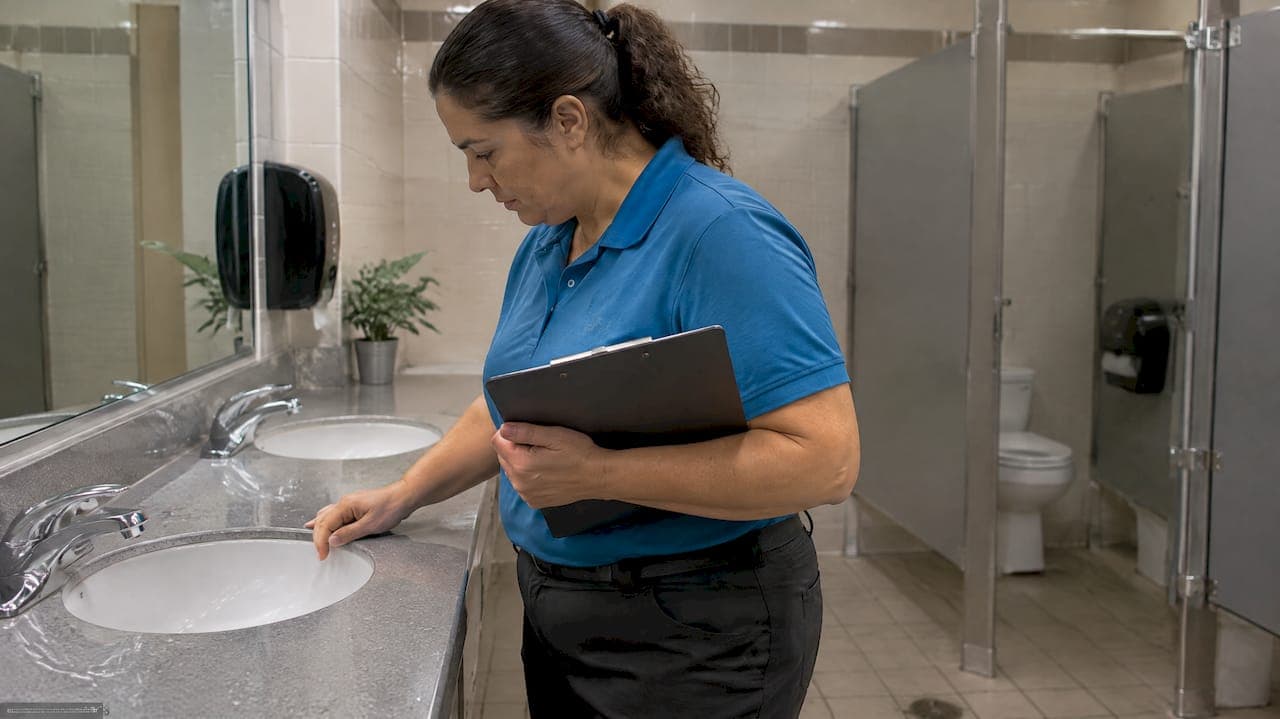
The cleaning quality control methods that work combine four things: a written standard everyone shares, scheduled inspections against it, objective testing where risk is high, and corrective action that is checked, not just logged. Skip any one and results drift. This guide shows property managers, facility directors and building owners how to build that system, whether you run cleaning in-house or oversee a contractor.
TL;DR
- Define "clean" in writing first. A shared scale such as the APPA five-level framework prevents most contract disputes.
- Inspect by risk, not equally. Audit high-traffic and critical zones more often, and score every visit the same way.
- Use objective tools (ATP or fluorescent markers) in healthcare and other high-risk spaces, and set baselines per surface.
- An inspection only counts if the fix is verified. Track time to correction, not just scores.
- Keep quality assurance (training, standards) and quality control (checking results) as separate jobs. You need both.
Table of Contents
- QA and QC: two different jobs
- Start with a standard everyone can read
- Inspection techniques that produce usable data
- Cleaning effectiveness metrics worth tracking
- Corrective action: where quality control actually pays
- Safety and training belong in the quality program
- Our perspective: what we see go wrong
- Choosing a certification or outside benchmark
- A 30-day rollout plan
- Need a cleaning partner who works to your standard?
- FAQ
- Sources
QA and QC: two different jobs
People use the terms interchangeably, but they do different work. Quality assurance is the system built to prevent failures: standards, training, scopes of work, supplies. Quality control is the checking of results to catch and fix failures. SiteClara's guide frames it well: great training with no inspections leaves you blind, while inspections with weak training mean you cycle through the same failures.
For a manager, the practical split looks like this:
| Quality assurance | Quality control | |
|---|---|---|
| Question | Is the process built to succeed? | Did this space meet the standard today? |
| Tools | Scope of work, SOPs, training, chemical program | Inspections, audits, testing, complaint tracking |
| Timing | Before and between jobs | During and after each service |
| Output | Standards and training plans | Scores, defects, corrective actions |
Start with a standard everyone can read
Inspections fail less because they are hard and more because nobody agreed what "clean" means. Without a shared vocabulary, a manager's expectations and a crew's performance drift apart, and that is where contract disputes begin.
The APPA custodial framework gives you that vocabulary. It defines five levels, from Level 1 (Orderly Spotlessness) through ordinary tidiness, casual inattention and moderate dinginess down to Level 5 (Unkempt Neglect). Many teams use it to write service-level agreements and to predict staffing needs.
To put it to work:
- Assign a target level to each area type. A lobby or an operating-room suite may warrant a higher level than a storage corridor.
- Write the level into the scope of work next to task lists and frequencies.
- Separate daily tasks, periodic tasks (carpet extraction, floor refinishing) and specialty work. Each gets its own frequency and standard.
- Walk the building with your cleaning provider once and score a few rooms together so both sides calibrate.
Frequency is part of the standard too. Our guides on cleaning frequency in large commercial buildings and deep cleaning frequency help you set those numbers.
Inspection techniques that produce usable data
Visual inspection with a scorecard
Visual inspection is the baseline method and the cheapest. Its weakness is subjectivity, which a scorecard fixes. Build one sheet per area type with 10 to 20 line items (floors, restroom fixtures, touchpoints, trash, dusting heights, glass), and score each pass/fail or on your chosen APPA-style level. Inspect top to bottom and back to front, the way a crew should clean, so you catch missed sequencing.
Sample, don't try to see everything
APPA guidance warns against a common mistake: auditing everything equally. Use your results to find high-traffic, critical zones and inspect those more often. That keeps the workload manageable and gives you objective data to justify budget or staffing changes to building owners. A simple approach is to inspect every restroom and entrance weekly, rotate through offices and back-of-house on a monthly cycle, and add extra visits to any area that fails twice in a row.

Process checks, not only surface checks
A surface can look fine on the day of the audit while the process is broken. Ask what an audit of method would reveal:
- Do crews know the step-by-step procedure for each task?
- What are the dwell times on your disinfectants, and are they honored?
- Is disinfectant rinsed where it should be?
- Is PPE worn and are safety precautions followed?
Those prompts come from an APPA custodial department evaluation presentation, and they turn an inspection from a glance into a real process evaluation.
Objective testing for high-risk spaces
Where infection control or regulatory exposure matters, your eyes are not enough. Two methods dominate:
- ATP bioluminescence measures organic residue and reports it as relative light units (RLUs).
- Fluorescent markers use a transparent gel applied before cleaning; if it is gone afterward, the surface was wiped.
A 2020 CDC-hosted study in an intensive care unit compared the two for terminal room cleaning and found no significant difference in effectiveness. The percent positive agreement for sufficient cleaning between them was 73.8%, so they do not always agree, and neither is a perfect verdict.
There are limits to respect. The CDC's environmental evaluation toolkit notes there is no standard method for measuring actual cleanliness, and ATP devices vary in sensitivity. The practical answer is to set your own pre-cleaning baseline for each surface type and measure improvement against that. For a worked program with thresholds, see our 30 to 60 day ATP testing program.
For healthcare settings, the CDC also publishes an environmental checklist for monitoring terminal cleaning listing priority high-touch sites such as bed rails, tray tables and IV poles. Use it as a starting model for your own list.
Cleaning effectiveness metrics worth tracking
More metrics is not better. Pick a handful you will actually review monthly.
| Metric | What it tells you | How to collect it |
|---|---|---|
| Average inspection score by area type | Whether the standard is being met | Scorecards, same scale each time |
| First-pass rate | Share of items passing without rework | Pass/fail tallies per inspection |
| Time to correction | Whether defects are actually fixed | Log defect time and verified fix time |
| Repeat-defect rate | Whether root causes are addressed | Same item failing on consecutive visits |
| Complaint volume and type | What occupants notice | Work-order or helpdesk data |
| ATP or marker pass rate (high-risk zones) | Objective cleanliness on tested surfaces | Tests against your baselines |
Time to correction deserves special attention. In healthcare cleaning, guidance summarized by SiteClara from NHS England standards suggests health-critical issues should be assessed within 20 minutes and rectified within an hour. That is a UK benchmark, and most US commercial buildings will not need it, but it shows how tightly a high-risk site can define response.
Corrective action: where quality control actually pays
An inspection that ends with a score has done half its job. The point is the fix, and the proof that it worked.
- Record the defect with a location and photo. Vague notes get vague repairs.
- Assign it to a named person with a deadline matched to risk.
- Re-inspect the same item. Close the ticket only on a verified pass.
- Look for the pattern. Three misses in one restroom point to a staffing, supply or training problem, not three separate mistakes.
- Share results with the crew. Proactive firms feed inspection data back to the cleaning team to adjust training or staffing quickly.
The lifecycle view used by regulators in pharmaceutical and healthcare settings applies here too. Health Canada's cleaning validation guide recommends designing effective procedures, qualifying that the process works under specified conditions, and then monitoring it on an ongoing basis. That is a useful mental model even for an office tower: prove the method, then keep checking it.
Safety and training belong in the quality program
A crew that cleans well but handles chemicals badly is a liability. Under OSHA's cleaning industry standards, the Hazard Communication Standard (29 CFR 1910.1200) requires employers to train workers on chemical hazards before they use the products, covering handling, PPE, safety data sheet access and labeling. That applies to "eco-friendly" products too. Add a training-records check to your audit: ask to see who was trained, when, and on which products. OSHA's publication Protecting Workers Who Use Cleaning Chemicals also advises choosing the least hazardous chemical that will accomplish the task.
On construction sites the same discipline applies. See our construction cleaning safety guide and crew supervision tips.
Our perspective: what we see go wrong
We clean offices, retail, multifamily, industrial and healthcare facilities, plus post-construction and tenant turn work. Our view of quality control is simple: it begins before the first crew arrives.
Our process has four steps: a quote, a site visit, scheduled cleaning, and customer approval. The site visit matters most for quality. It is where the scope, the areas that need a higher standard and the access constraints get written down, so that approval at the end is a comparison against something agreed, not an opinion.
A few things we would tell any property manager:
- Be specific about the end state. On a new build, "broom clean" and "ready for occupancy" are different deliverables. Our guides to cleaning standards for new commercial builds and post-build janitorial cleaning spell out the difference.
- Walk the job with the contractor at handoff. Contractors can use our cleaning compliance checklist to agree on what is being inspected.
- Treat a first failure as information. A missed item is a signal about scope, access or training. Fix the cause and you stop paying for the same rework.
- Put attention where traffic is. Our high-traffic area plan follows the same logic as risk-based inspection.
We work with local crews and respond quickly when something is off, because a defect left for a week becomes a tenant complaint.
— Sales
Choosing a certification or outside benchmark
If you want an external frame for a contractor's management system, look at ISSA's Cleaning Industry Management Standard (CIMS). It describes procedures and principles for designing and implementing quality management programs in cleaning organizations, and it is meant for both building service contractors and in-house operations. Ask any vendor you evaluate how their quality program is structured, whether they certify to a standard, and to show a blank inspection form and a recent corrective-action log. Their answers tell you more than a brochure.
A 30-day rollout plan
- Week 1: Choose target levels per area type and write them into the scope. Build scorecards.
- Week 2: Joint walkthrough with your cleaning provider. Score the same rooms separately and compare.
- Week 3: Begin scheduled inspections with risk-based frequency. Start the defect log with deadlines.
- Week 4: Review first-pass rate, time to correction and repeat defects. Adjust training, frequency or staffing, then repeat monthly.
Need a cleaning partner who works to your standard?
If you manage commercial property and want janitorial, tenant turn, post-construction, disinfecting or day porter service built around an agreed standard, request a quote from Sparkle Pro Commercial Cleaning. We start with a site visit so the scope matches your building.
FAQ
What is quality control in cleaning?
It is the inspection of completed cleaning against an agreed standard, plus the corrective action when work falls short. It covers scorecards, audits, objective testing and follow-up. Quality assurance, the training and standards behind it, is the companion system.
How often should commercial cleaning be inspected?
There is no universal number. Inspect critical and high-traffic zones such as restrooms and entrances most often, and rotate through lower-risk areas on a longer cycle. Increase frequency for any area that fails repeatedly, and use your own results to adjust.
Is ATP testing better than visual inspection?
For high-risk environments, objective methods give more actionable data than the eye alone. ATP readings vary by device and surface, though, so set baselines before cleaning for each surface type. Many sites use both visual scoring and testing.
How do I improve cleaning standards without raising costs?
Start by defining the standard in writing and focusing inspections on critical zones. Track repeat defects and fix their causes, usually training, supplies or scope, instead of paying for rework. Clear expectations alone often remove most disputes.
Sources
- APPA custodial guidelines training
- APPA custodial department evaluation presentation
- CDC study: fluorescent marker vs ATPase in an ICU
- CDC environmental evaluation toolkit
- CDC environmental checklist for monitoring terminal cleaning
- SiteClara: cleaning quality control
- Health Canada cleaning validation guide
- OSHA cleaning industry standards
- OSHA: Protecting Workers Who Use Cleaning Chemicals
- ISSA CIMS certification overview