

For most commercial building portfolios, a national direct-employment provider with local supervisory oversight is the strongest starting point. Schedule a site visit, request a written scope, and ask for a sample SLA before signing anything. That sequence alone separates serious vendors from ones who will disappoint you in month three.
The U.S. commercial cleaning market employs roughly 1.47 million workers across a sector valued at over $97.6 billion, which means you have no shortage of options and no shortage of ways to choose the wrong one. The difference between a reliable janitorial partner and a revolving-door vendor almost always comes down to delivery model, local management quality, and how clearly the scope is written before anyone picks up a mop.
Sparkleprocommercialcleaning operates as a nationwide commercial cleaning company with local operational knowledge, covering offices, retail, healthcare, industrial, and multifamily properties. Their four-step engagement process (quote, site visit, scheduled cleaning, customer approval) maps directly onto the procurement workflow this guide recommends.
Table of Contents
- What janitorial service providers for buildings actually cover
- Which building types need which services
- What a janitorial scope of work should include
- How janitorial services are priced
- How to choose the right janitorial vendor
- Staffing, access, and day-to-day operations
- How vendors should prove their performance
- How to get an accurate quote and what onboarding looks like
- Key Takeaways
- What property managers often get wrong about janitorial contracts
- Sparkleprocommercialcleaning covers your building from quote to clean
- Useful sources and further reading
What janitorial service providers for buildings actually cover
Commercial janitorial goes well beyond emptying trash and wiping counters. The services below represent what a full-service provider should be able to deliver, though not every item lands in a standard recurring contract.
Recurring contract services (typically included):
- General janitorial: daily or overnight cleaning of common areas, restrooms, break rooms, and offices
- Restroom sanitation: disinfection, fixture cleaning, consumable restocking (paper, soap, liners)
- Floor care: sweeping, mopping, and routine maintenance of hard-surface floors
- Carpet vacuuming and spot treatment
- Interior window and glass cleaning
- Day porter services: daytime staff for high-traffic lobbies, restrooms, and spills
Specialty services (typically billed as add-ons):
- VCT stripping and waxing, or concrete/stone floor refinishing
- Carpet extraction and deep cleaning
- Exterior and high-rise window cleaning
- Post-construction cleanup (rough clean, final clean, touch-up)
- Deep cleaning and disinfection (electrostatic or UV-C for healthcare and outbreak response)
- Environmental and cleanroom services requiring controlled-environment protocols
- Tenant move-out and turn cleaning
Eco-friendly options aligned with Green Seal or ISSA standards are increasingly available and worth requesting if your portfolio includes LEED-certified properties or tenants with sustainability mandates.
Which building types need which services
The right service mix depends on the building, not just the budget.
Office buildings generate moderate daily foot traffic and typically need nightly general janitorial, weekly floor care, and monthly deep cleans of high-touch surfaces. Open-plan offices with shared kitchens need more frequent restroom and break room attention than traditional private-office layouts.
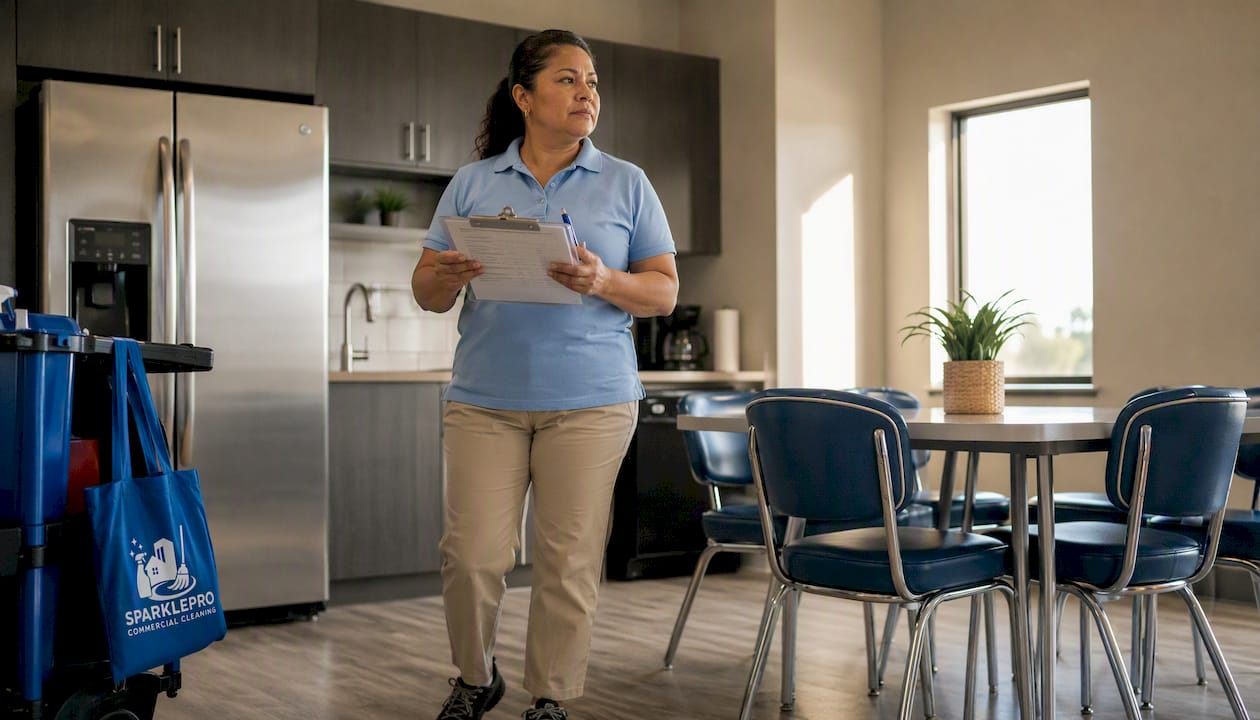
Retail spaces run harder. High customer volume means restrooms need multiple service visits per day, floors need daily mopping, and entrance glass gets cleaned constantly. Day porter coverage during business hours is often non-negotiable for grocery-anchored centers or busy strip malls.
Healthcare facilities carry the highest compliance burden. Terminal cleaning protocols, EPA-registered disinfectants, and documented cleaning logs are standard requirements. Providers serving hospitals, clinics, or medical office buildings should carry specific training credentials and be able to demonstrate familiarity with CDC environmental cleaning guidelines. Cleanroom environments require even tighter protocols, including gowning procedures and particle-count documentation.
Industrial and warehouse facilities need floor care scaled to large square footage, often including ride-on scrubbers, plus management of dust, debris, and sometimes hazardous material handling. Frequency is typically lower than office, but the labor intensity per visit is higher.
Multifamily properties focus on common areas: lobbies, hallways, laundry rooms, fitness centers, and parking structures. Tenant move-out cleaning is a recurring need that most property managers underestimate in scope and cost.
Post-construction sites require a phased approach. Rough cleaning removes debris and construction dust; final cleaning brings the space to occupancy standard; touch-up cleaning follows punch-list completion. Each phase has distinct labor and equipment requirements. The post-construction cleaning guide from Sparkleprocommercialcleaning walks through each phase in detail.
What a janitorial scope of work should include
A vague scope is the single biggest source of billing disputes and service failures. Before you sign, you should be able to hand a vendor's proposal to a new property manager and have them run the building from it.
Sample task frequency table:
| Task | Daily | Weekly | Monthly | Quarterly | Notes |
|---|---|---|---|---|---|
| Trash removal and liner replacement | ✓ | Vendor supplies liners | |||
| Restroom disinfection and restock | ✓ | Owner supplies consumables | |||
| Vacuuming carpeted areas | ✓ | ||||
| Damp mopping hard floors | ✓ | ||||
| Interior glass and partition cleaning | ✓ | ||||
| Dust surfaces, ledges, vents | ✓ | ||||
| Breakroom appliance wipe-down | ✓ | ||||
| Floor scrubbing or burnishing | ✓ | Equipment owned by vendor | |||
| Carpet extraction | ✓ | Billed as add-on | |||
| High-dusting (above 8 ft) | ✓ |
Common scope exclusions to confirm in writing:
- Exterior cleaning beyond entry glass
- Biohazard or blood-borne pathogen cleanup (requires separate certification)
- HVAC duct cleaning (though post-construction HVAC cleaning is a related specialty)
- Pest control or mold remediation
- Hazardous waste disposal
Consumables (paper products, soap, trash liners) are a frequent source of confusion. Clarify in the SOW whether the vendor supplies and bills them separately, the owner supplies them, or they are bundled into the monthly rate. Equipment ownership matters too: if the vendor owns the floor machines, confirm what happens when equipment fails and who covers repair delays.
How janitorial services are priced
Pricing models vary by provider and facility type. Understanding the model behind a quote is as important as the dollar figure itself.
| Pricing Model | How It Works | Best Fit | Pros | Cons |
|---|---|---|---|---|
| Per square foot | Monthly rate × cleanable sq ft | Offices, retail, multifamily | Easy to compare bids | Ignores layout complexity |
| Flat monthly rate | Fixed fee for defined scope | Single-site, stable operations | Predictable budgeting | Scope creep risk if not defined |
| Hourly/crew-based | Billed by labor hours per visit | Industrial, post-construction | Flexible for variable needs | Hard to budget; requires oversight |
| Unit-based add-ons | Per-event pricing (carpet clean, porter hours) | Specialty services | Pay only when needed | Can inflate total cost quickly |
Primary cost drivers to understand before you negotiate:
- Facility size and layout complexity (open floor plan vs. multi-tenant with many small suites)
- Cleaning frequency (nightly vs. three times per week vs. weekly)
- Staffing ratios required by your building's security or access policies
- Specialty services: disinfection programs, floor refinishing, and day porter coverage add meaningful cost
- Supply costs when bundled into the contract
- After-hours or weekend access, which often carries a labor premium
- Insurance requirements: large or regulated accounts commonly require $5M–$10M per-occurrence coverage, versus the $1M limits smaller operators typically carry
- Multi-site coordination and travel for portfolio-wide contracts
Request these items on every bid to make comparisons fair:
- Line-item scope of work with task frequencies
- Labor burden breakdown (wages, benefits, supervision)
- Consumables: included or owner-supplied
- Equipment ownership and replacement policy
- Insurance certificate with limits and additional insured language
- Contract term, renewal mechanism, and termination clause
Pro Tip: Ask every bidder to price against the same scope template you provide, not the scope they write themselves. Vendors who resist this are telling you something important about how they handle accountability.
How to choose the right janitorial vendor
The brand on the truck matters less than the person running your account.
National direct-employment providers offer layered account management: national account teams, regional operations directors, branch managers, and site supervisors. That structure supports multi-site portfolios and consolidated invoicing. Franchise networks offer geographic reach and standardized training, but service consistency depends heavily on the local franchise operator. A corporate promise from a franchise brand does not guarantee local execution quality, and franchisors often handle centralized billing while local franchisees manage on-site staffing, which can create a gap between what was sold and what gets delivered.
Essential questions to ask during the RFP or site visit:
- What are your general liability and workers' compensation insurance limits, and will you name us as an additional insured?
- Do you subcontract any portion of the work, and if so, how do you vet and supervise subcontractors?
- What is your annual employee turnover rate, and how do you handle coverage during absences?
- Describe your training curriculum: what does a new hire complete before working unsupervised on a client site?
- How often does a supervisor physically inspect our facility, and what does that inspection record look like?
- What KPIs do you track, and how do you report them to us monthly?
- What is your response SLA for a complaint or missed service, and what remedy do you offer?
- Can you provide three client references in a similar facility type, with contact names?
Red flags that should stop a negotiation:
- Scope described in vague terms ("clean as needed") with no task frequencies
- Auto-renewal clauses with no performance exit trigger
- References who are difficult to reach or give inconsistent accounts
- Insurance certificates that list limits below your building's requirements
- Inability to produce a sample SLA or inspection report template
- Pricing that is dramatically below market without a clear explanation
For contract evaluation, insist on a site-visit scoping addendum, defined KPIs, a written inspection cadence, and termination terms that let you exit for cause with 30 days' notice. Auto-renewal with a 90-day cancellation window and no performance clause is a trap.
Staffing, access, and day-to-day operations
Reliable cleaning depends on logistics that most RFPs never address until something goes wrong.
Staffing and supervision:
- Local supervisors who physically visit the site matter more than a national account manager who calls monthly. Ask specifically who supervises your account and how often they are on-site.
- Franchise-based providers vary significantly by local operator quality; evaluate the franchisee's own history, not just the brand's training program.
- Background checks should be standard for all staff with building access. Confirm the scope: criminal history, identity verification, and whether checks are repeated annually.
- Formal training programs should cover cleaning chemistry, equipment operation, safety (OSHA Hazard Communication), and your specific facility's protocols.
Access and security:
- Define key control procedures in the SOW: who holds master keys, how they are logged, and what happens if a key is lost.
- Badge access provisioning should be documented with a named contact on both sides.
- After-hours cleaning requires clear protocols for alarm codes, building lockup, and emergency contacts.
- Your property insurance carrier may have specific requirements for vendor indemnification; confirm before issuing access credentials.
Scheduling and coverage:
- Shift patterns (day, evening, overnight) affect labor cost and tenant disruption. Night cleaning is standard for most offices; day porter coverage supplements it during business hours.
- Confirm the vendor's absence coverage plan in writing. A crew of two with no backup plan is a service failure waiting to happen.
- Peak-season staffing (post-holiday deep cleans, post-construction, flu season disinfection) should be addressed in the contract or available as a documented add-on.
Onboarding coordination items to confirm before day one:
- Site keys and access credentials issued and logged
- Janitorial closet assigned, stocked, and accessible
- Vendor contact matrix (site supervisor, account manager, after-hours emergency line)
- Waste handling procedures and dumpster access confirmed
- Tenant communication sent if cleaning schedule affects business hours
How vendors should prove their performance
A vendor who cannot show you data is a vendor who is not measuring anything.
SLA elements worth requiring in every contract:
- Response time for a complaint or missed service (24 hours is a reasonable standard; 4 hours for urgent issues)
- Cleaning frequency adherence tracked against the agreed schedule
- Checklist completion rates from supervisory inspections
- Defined remedy process: re-clean at no charge, credit, or escalation path
Supervisory and inspection practices:
- Scheduled monthly inspections with a written report
- Random spot checks (unannounced) at least quarterly
- Tenant complaint tracking with resolution documentation
- Third-party audits available for regulated facilities
What a monthly performance report should include:
- KPI summary (inspection scores, complaint count, response times)
- Incident log with corrective actions taken
- Supply spend if consumables are vendor-managed
- Upcoming schedule changes or staffing notes
A good vendor will offer a single point of contact for your account and a clear escalation path above that person. Mobile reporting tools that let your team log issues in real time and track resolution are increasingly standard among top janitorial services nationwide. If a vendor cannot describe their escalation path in two sentences, that is a gap.
Stat to know: Large national providers commonly require $5M–$10M per-occurrence insurance for regulated accounts, compared to the $1M limits smaller operators typically carry. That gap matters when you are managing healthcare or federal facilities.
How to get an accurate quote and what onboarding looks like
The timeline from first contact to first clean typically runs three to six weeks for a straightforward commercial account. Regulated or complex facilities take longer.
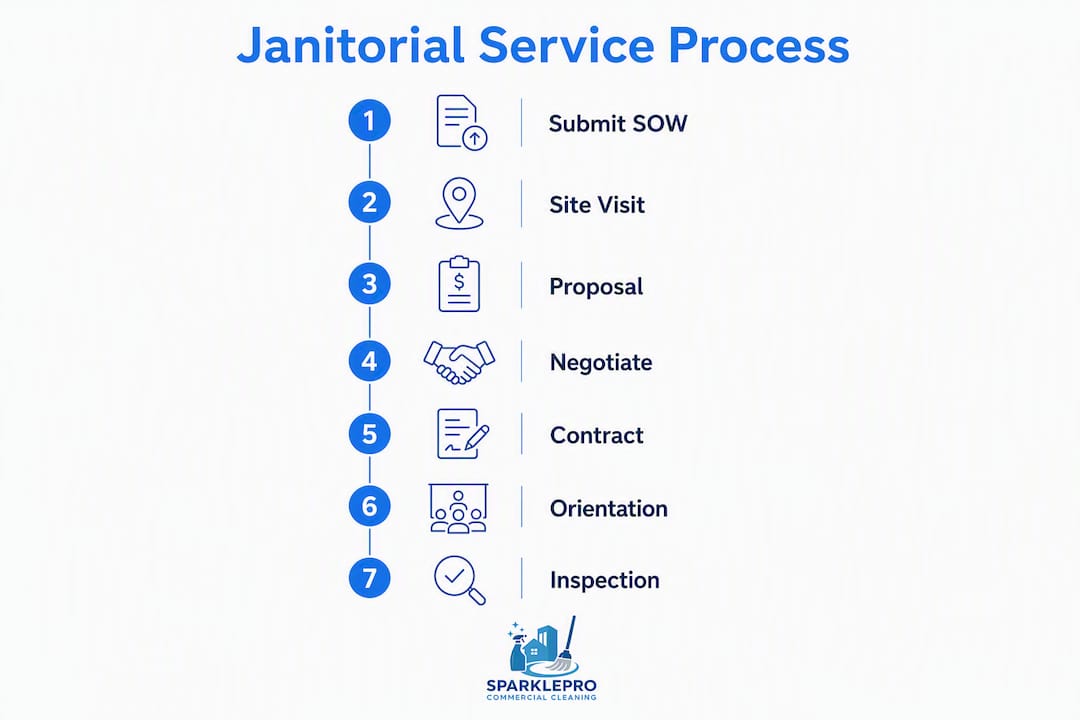
Step 1: Submit your SOW and floor plans (Days 1–3). Send the vendor a written scope template, floor plans with cleanable square footage, and your frequency requirements. Vendors who quote without this information are guessing.
Step 2: Site visit (Days 3–7). A qualified estimator walks the property, confirms square footage, identifies access points, reviews janitorial closet space, and notes any specialty requirements. This visit is where scope gaps get caught. Preparing your building before the visit saves time and produces a more accurate proposal.
Step 3: Line-item proposal (Days 7–14). A serious vendor returns a proposal within a week of the site visit. It should break out labor, consumables, equipment, and any add-on services separately.
Step 4: Negotiate scope and pricing (Days 14–21). Push back on vague line items, confirm insurance requirements, and align on KPIs and inspection cadence before you touch the contract.
Step 5: Contract signature and insurance confirmation (Days 21–28). Require a certificate of insurance naming your entity as additional insured before signing. Confirm the start date and orientation schedule.

Step 6: Orientation and first-week inspections (Days 28–35+). The vendor's supervisor should walk the site with your team before the first clean, then conduct daily inspections for the first week. This is where problems get caught early rather than at month three.
Pro Tip: Build a 30-day review meeting into the contract. A formal check-in at day 30 catches scope gaps, staffing issues, and communication problems before they become entrenched habits.
Common delays: access credential processing, insurance certificate revisions, and tenant notification requirements. Budget an extra week for any of these.
Key Takeaways
Choosing the right commercial cleaning partner comes down to delivery model, local management quality, and a scope detailed enough to hold anyone accountable.
| Point | Details |
|---|---|
| Match provider model to portfolio scale | National direct-employment providers suit multi-site portfolios; local independents work for single-site, lower-risk accounts. |
| Require proof of insurance and bonding | Large or regulated facilities should require $5M–$10M per-occurrence coverage, not the $1M limits smaller operators typically carry. |
| Demand a written scope and SLA | Vague scopes cause billing disputes; insist on task frequencies, KPIs, inspection cadence, and a 30-day termination-for-cause clause. |
| Evaluate local management, not brand alone | Franchise brand standards do not guarantee local execution; vet the franchisee's own references and inspection history. |
| Sparkleprocommercialcleaning as a next step | Sparkleprocommercialcleaning offers nationwide coverage with a four-step engagement process: quote, site visit, scheduled cleaning, and customer approval. |
What property managers often get wrong about janitorial contracts
The conventional wisdom says to get three bids and pick the middle one. That advice is not wrong, but it misses the real risk. The biggest failures in commercial janitorial contracts come from scope ambiguity, not price. A low bid against a vague scope will always look competitive until month two, when the vendor starts skipping tasks that were never written down.
The second thing most property managers underestimate is local management quality. A national brand with a strong training program can still deliver inconsistent service if the local supervisor is stretched across too many accounts or has high staff turnover. The brand name on the contract does not show up at your building at 11 PM. The local crew does.
The third mistake is treating the site visit as a formality. It is not. A thorough site visit is where a vendor earns or loses credibility. If an estimator spends 20 minutes walking a 200,000-square-foot facility and sends a quote the same afternoon, that quote is not based on your building. Push back, ask what they measured, and request a line-item breakdown that reflects what they actually saw.
Janitorial service is not a commodity. The right vendor, with a clear scope and a functioning inspection program, protects your asset, keeps tenants satisfied, and removes a persistent operational headache. The wrong one costs you twice: once in the contract, and again in the remediation.
Sparkleprocommercialcleaning covers your building from quote to clean
Property managers who need a single vendor for recurring janitorial, post-construction cleanup, day porter coverage, and specialized disinfection services have a direct option in Sparkleprocommercialcleaning. The company operates nationwide with local operational knowledge, which means you get the account management structure of a national provider without the franchise consistency gap.
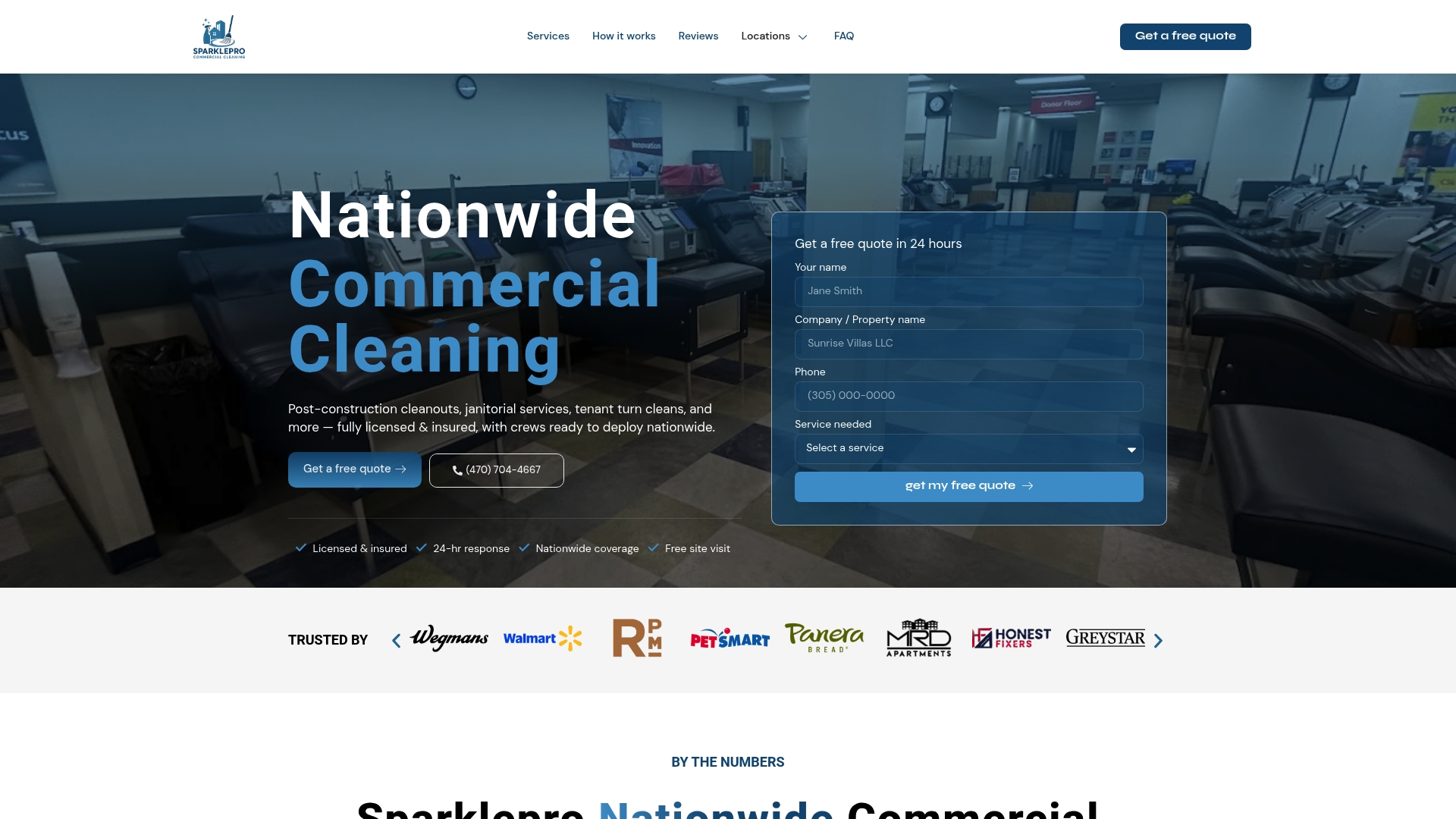
The engagement process is straightforward: request a quote, schedule a site visit, confirm the cleaning program, and sign off on the results. Every contract starts with a written scope developed after a physical site visit, so the proposal reflects your actual building, not a template. Sparkleprocommercialcleaning carries full licensing and insurance and serves offices, retail centers, healthcare facilities, industrial spaces, and multifamily properties across the United States.
If your facility is in Massachusetts or Washington, request a quote for your region and schedule a site visit this week. For all other locations, start at sparkleprocommercialcleaning.com to connect with the team and get a line-item proposal built around your building.
Useful sources and further reading
These resources support procurement decisions, standards compliance, and operational planning for commercial cleaning contracts.
- The 10 Largest Janitorial Companies in the United States — market size and workforce data for context on labor availability and provider scale.
- Commercial Post-Build Janitorial Cleaning: A Complete Guide — operational phasing for rough, final, and touch-up cleans; practical for GCs and property managers managing construction turnover.
- How to Evaluate Cleaning Contracts for Quality and Cost — contract evaluation framework with scoring criteria for scope, pricing, and performance terms.
- Effective Cleaning Solutions: Top Examples for Property Managers — practical service examples mapped to common property types; useful for scope development.
- Building Owner Cleaning Tips That Protect Your Property — owner-focused maintenance guidance to protect asset value between deep cleans.