
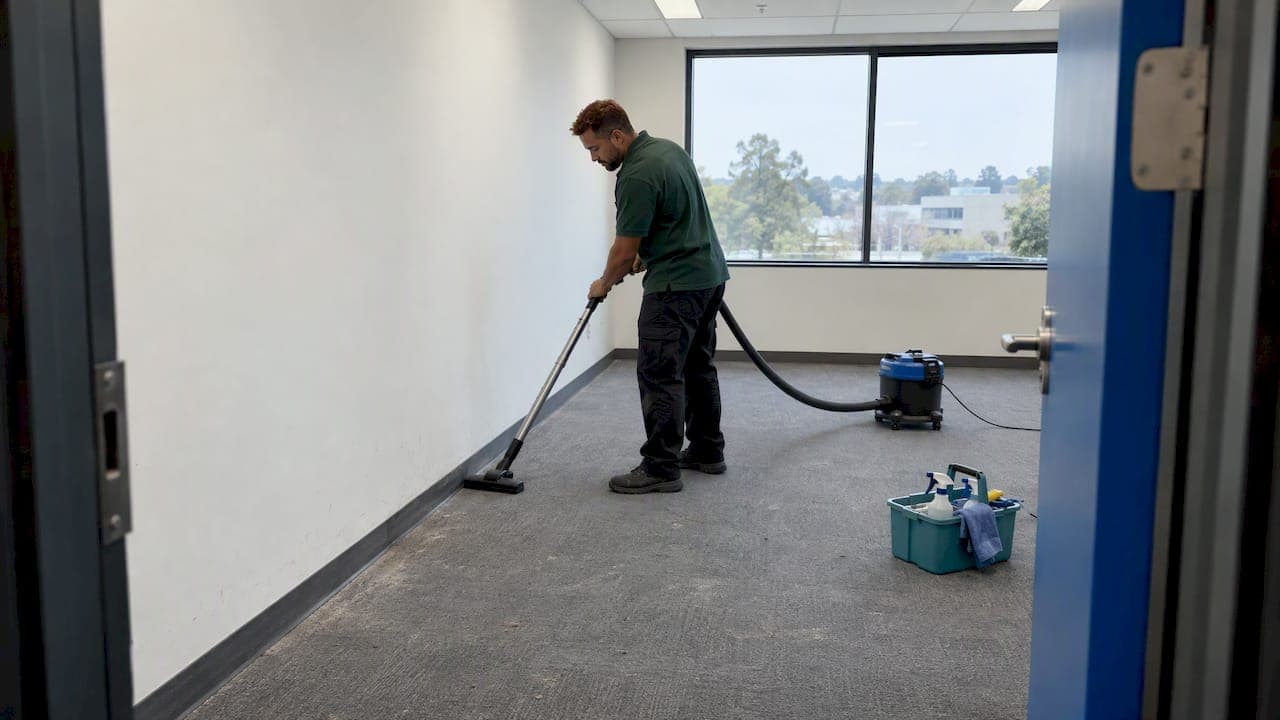
Office decommissioning cleaning is the final cleaning stage of closing out a leased office: after furniture, cabling and fixtures are out and repairs are done, the suite is cleaned to the standard the lease requires so the landlord accepts it back. Do it well and the handover is a short walkthrough. Do it badly and you face re-cleaning charges, deposit deductions or extra rent. This guide covers what the work includes, how to time it, what to document and what to ask a cleaning contractor before you sign.
TL;DR
- Decommissioning means returning the space to the condition the lease's surrender clause demands. Cleaning is the last step, not the whole job.
- Read the lease first. Requirements range from "broom-clean" to full restoration of the original condition, and the cleaning scope follows from that.
- Schedule the final clean after removals and repairs, and leave buffer before the lease end date. Cleaning too early means doing it twice.
- Keep dated photos, a written scope and a cleaning certificate, then get sign-off at a joint walkthrough with the landlord or property manager.
- Waste, lamps, batteries and electronics fall under federal and state rules, so confirm disposal before the crew arrives.
Table of Contents
- What office decommissioning cleaning actually covers
- Start with the lease, because it sets the standard
- The sequence: who works when
- What the cleaning scope should include
- Decommissioning cleaning versus a regular move-out clean
- Waste, safety and compliance
- Documentation that protects your deposit and your timeline
- What affects the cost
- How to choose a cleaning contractor for this job
- Our perspective
- Need the suite ready for handover?
- FAQ
- Sources
What office decommissioning cleaning actually covers
The term gets used loosely. Three services are often bundled together, and they are not the same:
- Decommissioning is the formal process of returning a leased suite to the condition its lease requires. It can include removing furniture, fixtures and equipment, pulling cabling, patching walls and cleaning.
- A cleanout is volume-based: everything comes out of the space. It does not on its own guarantee the suite meets lease terms.
- Liquidation is about recovering value from furniture and equipment, by selling or donating it.
Cleaning sits at the end of this chain. Once the movers, the cabling vendor and the repair trades have finished, the cleaning crew removes what they left behind: construction-type dust from drywall patching, adhesive residue, marks from removed partitions, dirty carpet and hard floors, and the film that settles on every surface of an empty room.
That is why the work resembles post-construction cleaning more than routine janitorial service. An empty office after a decommission is a light construction site. If you want the detail on that process, our step-by-step post-construction cleaning guide walks through the stages, and the final clean checklist breaks them out room by room.
Start with the lease, because it sets the standard
Every decommissioning project is defined by the surrender, restoration or "make-good" language in the lease. Two tenants in the same building can face very different obligations.
At one end, the lease asks only for the space to be left broom-clean: empty, swept, free of debris. At the other end, it asks for restoration to original or shell condition, which can include removing tenant improvements, custom partitions, signage and low-voltage cabling, repairing drywall and flooring, and repainting to the building standard. Most of the practical guides from relocation and installation companies describe this range, and it matches what property teams see in practice.
What to pull from the lease before you scope any cleaning:
- The surrender condition clause. Look for words such as "broom-clean," "good order and repair," "original condition" or "reasonable wear and tear excepted."
- The list of required removals. Cabling, signage, supplemental HVAC, kitchen equipment and security systems are the usual items.
- Deadlines and notice periods. Many leases require advance notice of move-out and a pre-surrender inspection.
- Holdover terms. Staying past the end date commonly triggers higher rent, so the cleaning window has to finish inside the term.
- Any landlord-approved vendor list or insurance requirements. Building management often asks contractors for certificates of insurance before they can enter.
If the language is unclear, ask a commercial real estate attorney to interpret it early, before the clock is running. A disagreement over what "original condition" means is far cheaper to settle in month one than on the last day.
The sequence: who works when
The order of trades matters more than any single cleaning technique. A workable sequence for a typical suite:
- Inventory and disposition. Decide what is being relocated, sold, donated, recycled or discarded.
- Data and IT. Wipe or destroy storage media and remove equipment through certified channels.
- Furniture and fixtures out. Systems furniture is disassembled, files and storage are cleared.
- Cabling, signage and fixtures removed. Electrical disconnections are handled by qualified people.
- Repairs. Patch and paint walls, replace damaged ceiling tiles, repair flooring.
- Final cleaning. This is the step that gets the suite to inspection standard.
- Joint walkthrough and sign-off.
Practitioners commonly start the physical work about 30 to 60 days before lease end, once assets are sorted. The final clean needs to land after step 5 and before step 7, with a few days of float. If cleaners go in before the painters, you pay for the same floors twice.
If the suite is large or the lease demands heavy restoration, a general contractor often coordinates the repair trades. In that case the cleaning contractor should be on the same schedule from day one, not called in after everything is finished. Contractor-side teams that manage projects like this may also find the overview of construction management software for U.S. contractors useful for tracking scheduling, field reports and compliance documents across trades.
What the cleaning scope should include
Ask for a written scope, not a square-foot number alone. For a decommissioned office, a thorough scope usually covers:
Debris and dust
- Removal of remaining trash, packing material and small debris from every room, closet and ceiling-accessible area
- HEPA-filtered or high-efficiency vacuuming of floors, ledges, window sills, tops of door frames and wall edges
- Wipe-down of surfaces after patching and sanding, since drywall dust travels
For more on why fine dust needs a different approach than ordinary sweeping, see our guide to concrete dust cleanup after construction. The same logic applies to drywall dust.
Floors
- Carpet extraction or deep cleaning, with spot treatment of stains and adhesive marks
- Hard floors: scraping tape and sticker residue, then mopping, and scrubbing or polishing if the lease calls for it
- Baseboards and thresholds
Walls, glass and fixtures
- Spot cleaning of walls and doors, scuff removal, and glass partition and interior window cleaning
- Light fixtures and vents wiped down
- Restrooms disinfected and descaled, with fixtures polished and dispensers emptied or removed
Kitchens and break rooms
- Refrigerators, microwaves and sinks emptied and cleaned inside and out, or removed if the lease requires
- Cabinets, counters and appliance surfaces degreased
If the suite includes a larger food-service area, our commercial kitchen cleanup guide covers the extra steps.
Disinfection
In some cases, such as healthcare tenants, labs or shared-touch environments, the lease or the landlord's next tenant may call for disinfection or specialized environmental cleaning on top of the standard scope. Raise that early, since it affects products, crew training and timing.
Decommissioning cleaning versus a regular move-out clean
A basic move-out clean assumes the space is already empty and in decent shape. Decommissioning cleaning assumes the opposite: surfaces have been disturbed, there is construction-type residue, and the result has to withstand an inspection against the lease. The practical differences:
| Factor | Basic move-out clean | Decommissioning cleaning |
|---|---|---|
| Starting condition | Mostly empty, light use | Post-removal, post-repair, dusty |
| Standard | General tidy | Lease surrender condition |
| Timing | Any time near move-out | After removals and repairs |
| Documentation | Often none | Photos, scope, certificate, sign-off |
| Coordination | Single visit | Scheduled with other trades |
If your project is a tenant turnover rather than a full closure, our tenant improvement cleaning guide explains the closely related requirements.
Waste, safety and compliance
Decommissioning produces mixed waste, and responsibility for it usually lands on the tenant or the contractor the tenant hired. Three areas deserve a check before work starts.
Combustible waste. OSHA's housekeeping guidance addresses disposing of combustible waste daily in covered metal receptacles. See OSHA's standard interpretation on daily disposal of combustible waste for the exact language. On a decommissioning site this means cardboard, packing material and rags should not pile up in corners overnight.

Lamps, batteries and electronics. Fluorescent lamps, batteries and mercury-containing equipment are typically handled as universal waste, which has streamlined handling rules that can differ by state. The EPA explains the basics in its universal waste FAQ. Check your state agency before assuming dumpster disposal is allowed.
Electrical work and cabling. Disconnections and low-voltage cable removal belong to qualified electricians and should be finished before cleaners enter the area. Cleaners should never be asked to deal with live or exposed wiring.
Our construction cleaning safety guide covers how a cleaning crew stays safe on sites with mixed trades, and our debris removal tips help with the bulk waste side.
IT equipment deserves its own note. Drives and storage media should be wiped or destroyed and the equipment moved through certified e-waste recyclers, with paperwork kept. Do that before the cleaning crew arrives, not during.
Documentation that protects your deposit and your timeline
Landlords decide whether a space is acceptable, so the goal is evidence they can accept quickly. Build this file as you go:
- Before photos of the space as you found it, ideally from move-in or before removals begin.
- After photos of every room once the cleaning is finished, dated and labeled by area.
- The written scope your cleaning contractor performed.
- A cleaning certificate or completion record. Landlords commonly ask for professional documentation that deep cleaning is done.
- Certificates of insurance for every contractor who entered the building.
- Written sign-off from the landlord or property manager after a joint walkthrough.
The joint walkthrough is the moment that matters. Schedule it with enough days left in the term that any punch-list items can be fixed without holdover exposure. Walk the suite room by room with the landlord's representative, photograph agreed conditions and get the acceptance in writing. Verbal approval is not a record.
What affects the cost
No honest number applies to every suite, and anyone quoting a flat price without seeing the space is guessing. The main drivers:
- Square footage and layout. Open floor plates clean faster than many small offices, and multi-floor suites add logistics.
- Starting condition. Heavy dust after demolition or patching adds labor.
- Lease standard. Broom-clean is far less work than restoration to original condition.
- Flooring types. Carpet extraction, adhesive removal and floor polishing each add steps.
- Special areas. Kitchens, server rooms, labs and healthcare spaces need extra procedures.
- Schedule constraints. After-hours access, short windows and elevator reservations all affect crew size.
- Access and waste handling. Loading dock rules and disposal requirements change the work.
The cost of getting it wrong is the reason to budget for it properly. Missing the deadline can lead to holdover rent, or to the landlord arranging remediation and charging you for it, often at rates higher than a planned professional job would have cost. Our pricing is based on property size, frequency and service scope, and we quote after a site visit rather than from a phone call.
How to choose a cleaning contractor for this job
Questions worth asking any vendor:
- Are you licensed and insured, and can you send a certificate of insurance to building management before the first day?
- Have you cleaned post-construction or post-removal spaces, not only occupied offices?
- Will someone visit the site before quoting?
- Can you work around the other trades and the building's access rules?
- What documentation will I receive at completion?
- How fast can you respond if the walkthrough produces a punch list?
The last question is easy to overlook. A landlord's re-inspection list arrives at the worst time, and a crew that can return within a day or so is worth more than a slightly lower quote. Our guide for hiring cleaning contractors on builder projects goes through vendor selection in more depth.
Our perspective
Most decommissioning problems we see are scheduling problems wearing a cleaning label. The cleaning is rarely the hard part. What goes wrong is that a crew is booked before the painters finish, the lease standard was never read, or nobody owns the punch list after the walkthrough.
So we start from the lease and the site visit. We ask what the surrender clause says, who else is working in the suite, and when the walkthrough is scheduled, and we scope backwards from there. For large or complex properties, including healthcare and post-construction spaces, we treat the final clean as a staged process: rough clean of debris and dust, detail clean of surfaces and fixtures, and a final inspection pass before anyone from the landlord's side walks the space.
Our local crews, licensing and insurance, and quoting process exist for exactly this kind of deadline-driven work. Our advice to property managers: involve your cleaning contractor when you build the decommissioning schedule, not when the schedule is already late.
— Sales
Need the suite ready for handover?
Sparklepro Commercial Cleaning provides post-construction cleaning, move-out and tenant turn cleans, deep cleans and disinfecting services for offices, retail, multifamily, industrial and healthcare properties across the United States. Our process is four steps: quote, site visit, scheduled cleaning and your approval. To start a quote for a vacated office, visit our commercial cleaning services page. Properties in the Garden State can go straight to our New Jersey commercial cleaning page.
FAQ
What does office decommissioning mean?
It means closing out a leased office and returning it to the condition the lease requires. That can include removing furniture, cabling and fixtures, repairing walls and floors, and a final professional clean. The exact scope comes from the lease's surrender clause.
Is decommissioning the same as an office cleanout?
No. A cleanout removes contents from the space, while decommissioning aims to meet lease terms, which may include repairs and restoration. A cleanout alone does not guarantee the landlord will accept the suite.
When should the final cleaning happen?
After furniture removal, cabling work and repairs are complete, and before the joint walkthrough. Leave several days of buffer inside the lease term so that any punch-list items can be corrected without triggering holdover rent.
How much does office decommissioning cleaning cost?
It depends on square footage, starting condition, flooring, special areas and the lease standard. We quote after a site visit so the price reflects the actual scope rather than a guess.
Do I need a cleaning certificate?
Landlords often ask for written proof that required cleaning is complete, so request a completion record from your contractor. Check your lease and ask building management what they will accept.
Sources
- OSHA standard interpretation: daily disposal of combustible waste
- US EPA: Frequent questions about universal waste
- CivroBuild: construction management software for U.S. contractors