
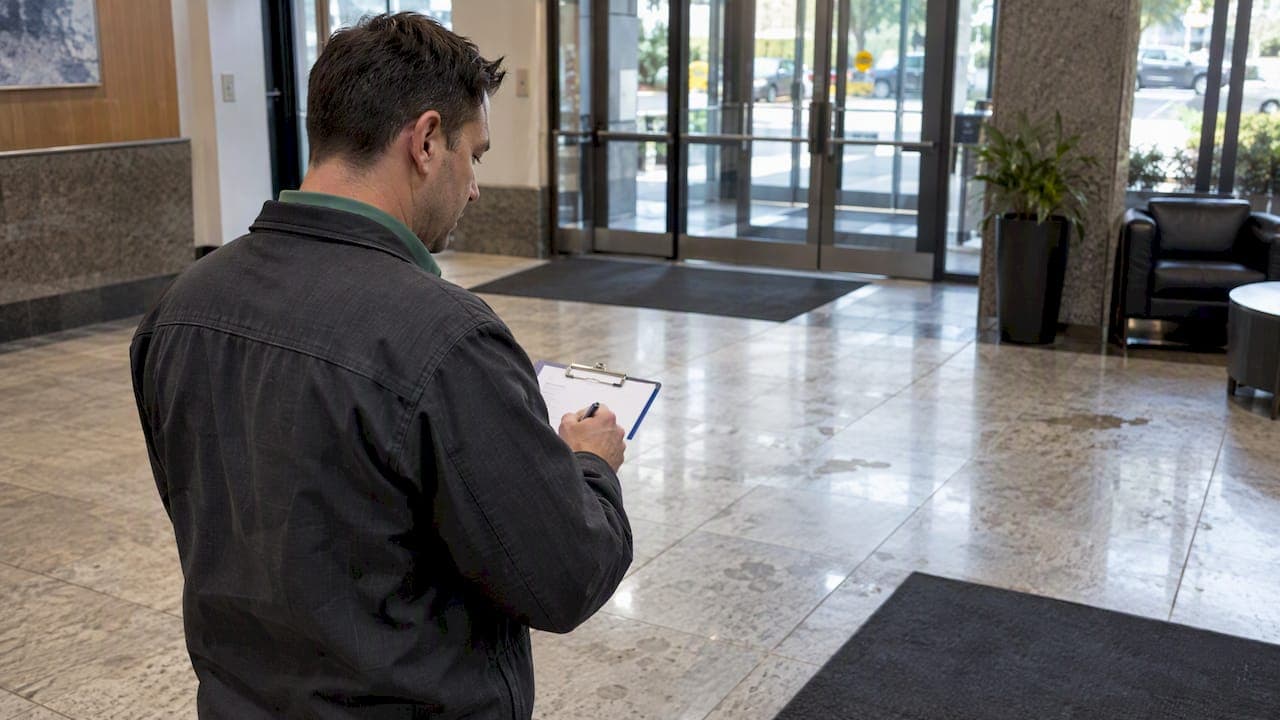
A good janitorial inspection score tells you two things: whether the building is clean today, and whether the trend is moving the right way. To get there, score each item against a condition an inspector can see, weight the items that matter most (restrooms, lobbies, high-touch points), set thresholds that trigger action, and calibrate every inspector against the same standard. The rest of this guide shows how, with a worked example you can adapt to your own contract.
TL;DR
- Pass/fail items turn into a percentage that is easy to trend. Rating scales (1 to 3, 1 to 5, APPA levels) capture nuance but depend more on who is grading.
- Weight the scorecard. A plain percentage treats a dirty storage closet like a dirty lobby restroom, and your tenants do not.
- Write the thresholds into the contract: what score is acceptable, what triggers remediation, and which failures need action regardless of the total.
- Inspect unannounced, walk the building jointly with the cleaning supervisor now and then, and compare scores with occupant complaints.
Table of Contents
- What a janitorial inspection score is for
- The main scoring methods compared
- Why a plain percentage misleads
- Building a weighted scorecard step by step
- Going beyond task audits: outcome-based scorecards
- Making the numbers trustworthy
- Add compliance to the checklist
- Our perspective: what we see across properties
- Setting up scoring for a new contract
- Work with a crew that welcomes inspection
- Common scoring mistakes to avoid
- FAQ
- Sources
What a janitorial inspection score is for
An inspection score is a measurement, not a verdict. Its job is to give property managers and cleaning contractors a shared, repeatable number so that a conversation about quality starts from evidence rather than impressions.
The OrangeQC guide to inspection checklists describes a useful inspection as one that covers only the areas the cleaning team is responsible for, gathers concrete data such as a final score, action items and deficiencies, and is scored consistently. That last point is where most programs fail. If two inspectors score the same lobby differently, the trend line you draw from their numbers means nothing.
If you are still deciding what to measure in the first place, our guide to facility cleaning KPIs and our overview of cleaning quality control methods cover the wider picture. This article stays on one question: how to turn what an inspector sees into a number you can trust.
The main scoring methods compared
There is no single best system. CleaningQA's comparison of scoring systems makes the same point: pass/fail is fast and clear, while a rating scale captures more nuance but asks inspectors to make finer judgments. Here is how the common options stack up in practice.
| Method | How it works | Strength | Weakness | Best for |
|---|---|---|---|---|
| Pass/fail | Each item meets the agreed condition or does not | Fast, objective, easy to convert to a percentage | No sense of how close a failure was | Routine janitorial contracts, frequent inspections |
| 3-point rating | Excellent, acceptable, needs improvement | Simple, shows some gradation | Middle score becomes a default | Quick walk-throughs by managers |
| 5-point rating | 1 to 5 per item | Detailed trend data | Highest inspector-to-inspector variation | Larger portfolios with trained inspectors |
| APPA levels | Five defined levels of cleanliness for an area | Recognized benchmark, supports SLAs | Needs training to apply consistently | Institutional, educational and healthcare-adjacent buildings |
| Weighted scorecard | Any of the above, with items multiplied by importance | Reflects real priorities | Needs setup and agreement up front | Contracts with penalties or renewal triggers |
Published guidance on checklists commonly describes rating systems from 1 to 5 or percentages from 1 to 100, so you will meet both in the wild. The key is to pick one and write down what each score means.
Pass/fail: score conditions, not opinions
A pass/fail item asks whether a condition is true. "Sinks free of visible soil, water spots and residue" is a condition. "Restroom looks clean" is an opinion. The CleanLog monthly audit guide shows a clean way to calculate the result: grade each sampled element pass or fail, mark missing fittings N/A, and divide elements passed by applicable elements inspected. It also advises recording unreachable items for follow-up rather than counting them as a pass, which keeps the score honest.
Rating scales: use them where judgment is real
Some things are legitimately a matter of degree, such as the overall appearance of a polished floor. For those, a short scale with written descriptions for every level works better than a bare 1 to 5. If you cannot describe the difference between a 3 and a 4 in one sentence, drop to three levels.
APPA levels: a shared vocabulary
The APPA Custodial Effectiveness Assessment uses five levels of cleanliness, where Level 1 is the highest order of cleanliness and Level 5 is the most neglected. The U.S. Green Building Council reference guide for green cleaning in existing buildings tells teams to build audit forms based on APPA's operational guidelines, or on another method at least as stringent. APPA's own page explains that a custodial audit exists to document practices and judge how well they support the institution's mission (APPA cleaning operations).
For a commercial office, a contract that says "Level 2 in offices, Level 1 in restrooms and entry" gives both sides a reference point that existed before the dispute did.
Why a plain percentage misleads
A flat percentage treats every line as equal. A building can score 92% while the lobby restroom, the one space every visitor sees, fails three items. CleaningQA notes that weighted scoring lets restrooms, entrance lobbies and high-touch points carry more influence than storage rooms or office floor corners, and that a failure in a heavily weighted category should trigger corrective action whatever the overall percentage says.
That last rule is worth copying into your contract. Call it a critical-item override: a defined list of items (for example, restroom sanitation, trip hazards, missing soap or paper, blocked egress from a cleaning cart) where a single failure requires a documented fix within a set time, no matter how good the total looks.
Building a weighted scorecard step by step
- List the areas and tasks you actually pay for. Use the scope of work, not a generic template. Items outside the scope will generate arguments.
- Sort items into tiers. One published framework, from Wipyly's SLA-aligned audit guide (July 2026), suggests Tier 1 for critical safety, health or high-traffic items at 40% of the score, Tier 2 for client satisfaction drivers at 35%, and Tier 3 for internal operational quality at 25%. Treat those numbers as a starting point, not a standard.
- Write each item as an observable condition. If a new inspector cannot score it without asking someone, rewrite it.
- Choose the scoring method per tier. Pass/fail for most items, a short rating for the few appearance judgments.
- Set thresholds. The same Wipyly guidance suggests a total below 70% should trigger immediate remediation and below 50% enters penalty territory. Your own numbers should come from your lease obligations, tenant expectations and contract terms.
- Define the response. For each threshold, state who is notified, the correction deadline and when the area is re-inspected.
A worked example
Say a 40,000 square foot office building is inspected using 30 sampled items. Eight are Tier 1 (restrooms, lobby, high-touch disinfection, elevator cabs), ten are Tier 2 (common-area floors, glass, break rooms) and twelve are Tier 3 (storage, stairwell corners, vents).
Results: Tier 1 passes 6 of 8 (75%), Tier 2 passes 9 of 10 (90%), Tier 3 passes 12 of 12 (100%).
Using the 40/35/25 weights: (0.75 × 40) + (0.90 × 35) + (1.00 × 25) = 30 + 31.5 + 25 = 86.5.
A flat count would show 27 of 30, or 90%. The weighted result is lower because the failures sit in the items occupants notice most. If your contract also has a critical-item override, the two failed Tier 1 items would each need a documented correction regardless of the 86.5.

The arithmetic is simple. What matters is that both parties agreed to it before the first inspection.
Going beyond task audits: outcome-based scorecards
Inspection results are only part of what a service provider contributes. Singapore's National Environment Agency, in its guide to outcome-based cleaning contracts, discusses performance measurement through quantifiable KPIs, with payment tied to outcomes being achieved. It is a public-sector document from another country, so use it as a model for structure rather than as a U.S. standard. One way to apply the idea: weight inspection results at around 60% of a vendor scorecard, responsiveness to ad-hoc requests at 20%, valid complaints at 10%, and use the remainder for whatever else your property values, such as documentation or reporting.
This works well with day porter and facility service arrangements, where responsiveness between scheduled cleans is part of what you are buying.
Making the numbers trustworthy
Inspect without warning
Announced inspections measure how well a crew can prepare, not how the building is kept. The USGBC guide advises that inspections happen without advance notice to custodial staff, so you see the true daily condition and avoid a pattern of cleaning just to pass. Unannounced does not mean ambush: tell the contractor in the contract that spot inspections will occur, and share the form beforehand.
Calibrate your inspectors
Every portfolio has a hard grader and a lenient one. OrangeQC recommends joint inspections, where the client and the cleaning supervisor walk the space together, score independently, then compare. Do this each quarter on the same few rooms. When two people differ by more than one point on an item, the wording of the item needs work, not the people.
Sample sensibly
You rarely need to inspect every room. A published example in the research for this article describes APPA-based audits covering about 10% of rooms, and a comprehensive commercial audit checklist of roughly 36 items taking 45 to 60 minutes for a single facility (see the POPProbe checklist). Rotate which rooms you sample so the crew cannot predict them, and always include the critical areas.
Compare scores with what occupants say
APPA's guidance treats inspection as continuous improvement rather than grading. Compare your scores with logged compliments and complaints from occupants. When the two disagree, either the inspection criteria are measuring the wrong things or the crew needs more training. A building scoring 95% with a steady stream of restroom complaints has a scorecard problem.
Add compliance to the checklist
Cleaning quality is not only appearance. Inspections should also verify that chemical handling meets the OSHA Hazard Communication Standard, 29 CFR 1910.1200: Safety Data Sheets accessible, chemical containers labeled, and training documented for hazardous agents used on site. Score these as pass/fail Tier 1 items. Our guides on OSHA cleaning compliance and SDS audits and industrial cleaning safety walk through what to check. For active job sites, see the construction cleaning safety guide.
If your property pursues green certification or a sustainable cleaning program, build those requirements in too. The Green Seal GS-42 standard requires a written cleaning plan for each building, including minimum frequencies for routine operations, which gives you ready-made items to inspect against. For schools and institutional facilities, ISSA Clean Standards pair a traditional audit with ATP meter testing, a useful objective check where visual scoring is not enough.

Our perspective: what we see across properties
We clean office buildings, retail centers, multifamily, industrial and healthcare facilities, and the scoring conversations that go well share three traits.
First, the standard is written before the contract starts. When a property manager shows us the scorecard during the quote and site visit, we can price the work against it and staff the crew accordingly. Surprises arrive when a scorecard appears in month four.
Second, we welcome joint walk-throughs. Our model relies on local crews and a personal relationship with each property, so a supervisor standing next to you with the same form is how problems get fixed in a day instead of arguing at renewal.
Third, we favor scorecards that distinguish what is critical from what is cosmetic. Healthcare environments, post-construction final cleans and disinfecting programs have items where "almost" is a fail. Office storage rooms do not. A scorecard that says so lets everyone spend attention where it counts.
One caution from experience: do not let a score become the goal. A crew that learns to ace a form but ignores what tenants actually notice has beaten the system, not served the building.
— Sales
Setting up scoring for a new contract
If you are bringing on a vendor or renegotiating, put these into the agreement:
- The scorecard itself, attached as an exhibit, with weights and item definitions.
- The inspection frequency and who inspects (manager, third party, or both).
- Thresholds and the response for each, including the critical-item override.
- The correction window and re-inspection process.
- How scores feed into renewal decisions.
Our guides on evaluating cleaning contracts for quality and cost and how to approve cleaning services go deeper on contract language and sign-off. For construction handovers, the final clean checklist, the contractor compliance checklist and the standards for new commercial builds show how the same scoring logic applies to a one-time clean.
Work with a crew that welcomes inspection
Sparklepro Commercial Cleaning is a nationwide, licensed and insured commercial cleaning company with local crews. We provide routine janitorial and day porter services, post-construction cleanouts, tenant turn and move-out cleans, deep cleans, disinfecting and environmental services for healthcare settings. Our process starts with a quote and a site visit, which is the right moment to agree on how the work will be scored. Request a quote on our main site and bring your scorecard with you. If your properties are in the Garden State, see our New Jersey page.
Common scoring mistakes to avoid
- Scoring what is not in the scope. The crew is graded on a window ledge nobody contracted to clean. Match the form to the scope.
- Inspecting only at the end of the shift. Check at different times. A lobby that is spotless at 6 a.m. can look different at 2 p.m., which is where day porter coverage matters.
- Averaging away the problems. Report area scores alongside the building score so one weak restroom does not vanish into a good total.
- Changing the form mid-contract. Revising items without notice makes trends meaningless. Version the form and announce changes.
- Ignoring N/A. Dropping an item that does not apply to a room is correct. Counting it as a pass inflates the score.
- Skipping the follow-up. A deficiency list nobody re-checks teaches the crew that scores do not matter.
FAQ
What is a good janitorial inspection score?
It depends on how your scorecard is built, so define it in the contract. One published framework suggests that below 70% should trigger immediate remediation and below 50% enters penalty territory (Wipyly). Many managers set a target well above that for routine service, and add a critical-item override so that serious failures count whatever the total.
Should I use pass/fail or a 1 to 5 rating?
Use pass/fail for most items, because a condition is either met or not and the result converts to a clean percentage. Save rating scales for judgments that are truly a matter of degree, and write a one-sentence definition for each level.
How often should buildings be inspected?
The right frequency follows risk and contract terms. High-traffic or healthcare spaces warrant more frequent checks than low-use offices, and new contracts benefit from more inspections early on. A monthly formal audit with shorter spot checks in between is a common pattern.
Who should do the inspecting?
The property or facility manager is the most direct choice, with the cleaning contractor's supervisor joining periodic joint walk-throughs for calibration. Either party can add a third-party inspector for an independent view, particularly for disputed scores or certification work.
Sources
- APPA: Cleaning Operations
- U.S. Green Building Council: Custodial Effectiveness Assessment reference guide
- Wipyly: SLA-aligned commercial cleaning audit checklist with scoring
- CleaningQA: Cleaning inspection scoring systems
- OrangeQC: Janitorial inspection checklist guide
- CleanLog: Monthly cleaning audit checklist
- POPProbe: Commercial cleaning quality audit checklist
- Singapore NEA: Guide on outcome-based cleaning contracts
- Green Seal: GS-42 Standard for Commercial and Institutional Cleaning Services
- ISSA: Clean Standards