
Pre-occupancy cleaning is the final, detailed clean of a commercial space after construction or a tenant turn and before the new occupant moves in. It removes construction dust, debris, residue and stickers. It also leaves floors, glass, restrooms and kitchens ready for use. Done well, it is a staged process that ends with a documented walk-through, not a single sweep the day before keys change hands.
This guide is for property managers, general contractors, building owners and facility managers who have to schedule, scope and sign off on that work. It covers what is included, the right timing, the order of work, safety rules, how to adapt the plan to different building types and how to prove the space is ready.
TL;DR
- Pre-occupancy cleaning is the last clean before move-in. It follows trade completion and the punch list, and it comes after any rough clean done during construction.
- Work top to bottom and back of the room to the door, with floors last. Inspect room by room with a signed checklist.
- Construction safety rules, not everyday janitorial habits, govern cleaning on an active site: HEPA vacuums, wet methods, PPE and debris control.
- Cleaning sign-off does not authorize occupancy. Final inspections and the certificate of occupancy come from the local building authority.
- Book the final clean against a trigger (trades out, punch list closed), not a calendar date, and leave room for a touch-up pass.
Table of Contents
- What pre-occupancy cleaning includes
- When to schedule it
- The order of work
- How to clean the high-use areas
- Safety on site
- Adapting the plan to the building type
- How to inspect and document readiness
- Move-in cleaning after the certificate
- Writing a scope that avoids disputes
- Plan your pre-occupancy clean with us
- FAQ
- Sources
What pre-occupancy cleaning includes
The name varies. Contractors say final clean or construction clean. Property managers say turnover clean, move-in clean or tenant turn. The scope is the same idea: take a space that is built or vacated and bring it to a condition where a tenant can place furniture, stock shelves or see patients without finding the job half finished.
A typical scope covers:
- High work: light fixtures, vents, ceiling grids, sprinkler heads, door frames and the tops of partitions and cabinets, where settled dust collects.
- Walls and partitions: dust removal, spot cleaning, removal of tape, labels and protective film, and paint or adhesive splatter where it can be removed safely.
- Glass and windows: interior and exterior panes, tracks and sills, with stickers and manufacturer labels removed.
- Doors and hardware: frames, handles, kick plates and closers.
- Restrooms: fixtures, partitions, mirrors, dispensers, drains and floors, cleaned and sanitized.
- Kitchens and break rooms: cabinets inside and out, countertops, sinks, appliances and backsplashes.
- Floors: vacuuming, mopping, scrubbing, carpet extraction or hard-floor finishing, always the last surface touched.
- Building systems and exterior areas: vent covers, entry mats and vestibules, loading areas and walkways near the entrance.
That order follows a post-construction checklist that splits the work into three phases and moves top to bottom, back of the room to the door. Our own final clean checklist breaks the same work into three stages, room by room.
What it is not
It is not routine janitorial service. Janitorial work maintains an occupied building on a schedule. Pre-occupancy work removes the by-products of construction or a prior tenant's use, usually in one concentrated push. Once the tenant is in, post-build janitorial cleaning takes over to keep the space at the standard you just reached.
When to schedule it
The common mistake is booking by date. Construction slips, inspections fail, and a cleaning crew arrives while painters are still working. Schedule against triggers instead.
| Phase | Trigger | Purpose |
|---|---|---|
| Rough clean | Trades are still on site, areas are released in stages | Remove debris and heavy dust so work can continue safely and later cleaning is easier |
| Final clean | Trades are complete in an area | Detailed top-to-bottom clean to occupancy standard |
| Touch-up | After the punch list is closed, before move-in | Remove fresh dust and marks left by punch-list repairs |
The touch-up is the step most often skipped, and it is the one the tenant notices. A ceiling tile replaced or a door adjusted on punch-list day leaves dust on a floor you finished the day before. Plan a short, final pass after the last repair and before the tenant's first walk-through. Our guide to booking rough and final cleans by trigger explains how to tie each phase to a construction milestone.
Working backward from move-in
- Fix the tenant's move-in or opening date.
- Subtract the time for final inspections and any re-inspection.
- Subtract the touch-up pass, usually a day or less on a mid-size suite.
- Subtract the final clean, sized by square footage, finish level and number of restrooms and kitchens.
- Confirm that trades will be out of each area by then, and build in a buffer for slippage.
A larger or more complex building is better cleaned in zones, so the final clean starts on floors that are trade-complete while others are still being finished. That requires the superintendent to release areas formally, which leads to the first step of the sequence below.
The order of work
A sequence that holds up on most commercial projects, as laid out in the checklist referenced above, runs like this:
- Walk the job with the superintendent. Agree on scope, which areas are ready and which are not.
- Get the hazard information. Ask about dust risks and the contractor's exposure control plan before anyone starts.
- Rough clean released areas using HEPA vacuums and wet methods rather than dry sweeping.
- Final clean top down once an area is trade-complete, with floors last and the crew working toward the exit.
- Inspect each room with a supervisor.
- Walk the area with the owner's representative and record any cleaning items.
- Touch up after the punch list, then hand over.
The reasoning is simple. Dust and debris fall. Clean the ceiling after the floor and you do the floor twice. Work toward the door and no one walks across a finished surface to leave.
The full process is covered in our step-by-step post-construction cleaning guide.
How to clean the high-use areas
Dust and debris
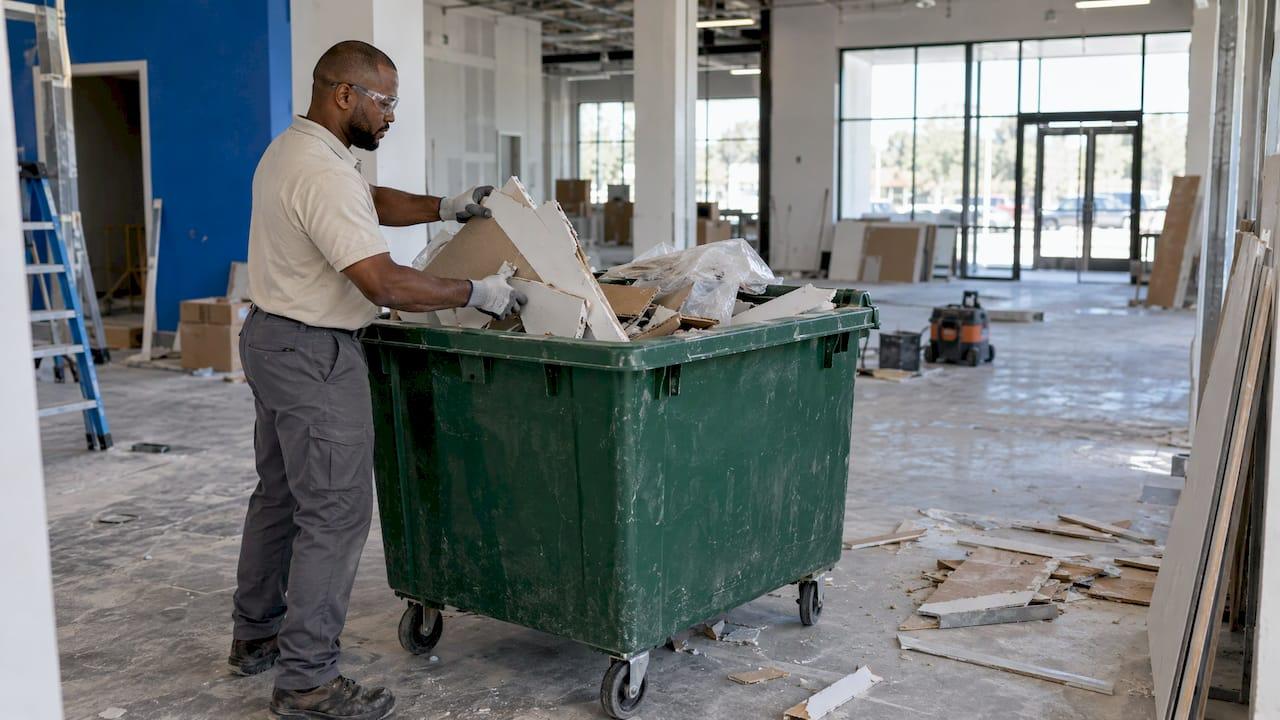
Bulk debris leaves first: packaging, offcuts, pallets, fasteners and drywall scrap. Planning the dumpster, the haul route and the removal schedule saves days. Our debris removal tips for property managers cover those logistics.
Fine dust is the harder problem. It settles on every horizontal surface and gets into HVAC returns, door tracks and carpet. Professional-grade equipment matters here. NCCER's guidance notes that post-construction work uses gear that differs from everyday janitorial supplies, including floor scrubbers, buffers, professional vacuums and carpet extractors, pressure washers and heavy-duty trash containers, along with PPE.

Floors
Floors come last and depend on the material:
- Sealed concrete and resilient tile: remove dried spills and adhesive, auto-scrub, then finish or burnish as specified.
- Carpet and carpet tile: HEPA vacuum first, then extract. Check the flooring manufacturer's cleaning requirements, since some warranties specify methods.
- Hardwood and specialty surfaces: use products and methods the installer approves.
Protect finished floors from foot traffic after cleaning. Runners or floor protection at entries cost little compared with a re-clean.
Windows and glass
Remove labels and film first, scrape paint overspray only with tools that will not scratch the glass, then wash. Do interior and exterior in the same visit when access allows, so streaks from one side do not undo the other.

Restrooms, kitchens and break rooms
These are the rooms where a tenant judges quality fastest. Clean and sanitize fixtures, remove protective films from stainless steel and dispensers, clean inside cabinets and drawers and wipe appliances inside and out. Check drains and traps for grout and drywall residue.
Safety on site
A building that is not yet occupied is often still a construction site, and cleaning crews on it work under construction rules. One contractor guide states that OSHA's 29 CFR Part 1926 construction standards govern cleaning during active-site phases rather than the general-industry standards in Part 1910.
OSHA's construction housekeeping standard, 1926.25, addresses the clearing of scrap and debris from work areas, passageways and stairs during construction. In practice, that means debris is not left to pile up where people work or walk.
Practical precautions to build into the scope:
- Dust control: HEPA vacuums and wet methods in place of dry sweeping or compressed air. Ask the general contractor for any exposure control plan before work starts.
- PPE: gloves, eye protection and respiratory protection as the site's hazard assessment requires. Ask the contractor what dust the trades created, including cutting of concrete, masonry or tile.
- Chemicals: use only products suited to the surface, never mix them, and keep safety data sheets on site. Ventilate rooms during strippers and degreasers, and keep other trades out of the area during use.
- Waste: keep debris in labeled containers, route it to the dumpster and keep exits and stairs clear.
- Access: coordinate with the superintendent on lockout of active systems, wet floors and overhead work.
Our construction cleaning safety guide for site managers goes deeper into requirements, and tenant improvement cleaning covers OSHA and EPA readiness for occupied-building projects. For industrial sites, see industrial cleaning safety.
Adapting the plan to the building type
The sequence stays the same. What changes is the standard, the products and the tolerance for dust.
| Building type | What shifts in the plan |
|---|---|
| Office | Focus on glass, carpet, restrooms and kitchenettes. Floor-by-floor release works well, and the tenant often wants a clean on the day furniture arrives. |
| Retail | Storefront glass, entry vestibules and sales-floor finishes come first in priority. Fixtures and displays arrive after cleaning, so a second light clean before opening is common. |
| Healthcare | Dust control is stricter and surfaces need disinfecting. Rooms may need a specific protocol set by the facility's infection prevention team. Get that protocol before scoping. |
| Industrial | Heavy debris, floor coatings, high racking and large floor areas. Machinery and process zones need coordination with the operator. |
| Multifamily | Many repeated units with a consistent checklist. Common areas, amenity spaces and units are scheduled in batches. |
For properties pursuing green building certification, ask for eco-friendly products up front so they are specified rather than substituted at the last minute.
How to inspect and document readiness
A clean that cannot be shown is hard to accept and harder to dispute. Use a simple record:
- Signed room or zone checklist. One line per area, with initials and the date.
- Representative-area inspection, then the whole space. Review one room or floor in detail first so standards are agreed, then walk the rest.
- Photographs of each completed phase. They settle later arguments about what condition a space was in.
- A defect log. Assign each item to cleaning, construction, management or another provider, so cleaning does not absorb punch-list work.
- Corrective work before the turnover walk. Close items first, then walk with the owner's representative.
This follows the approach in a municipal certificate-of-occupancy process document, which also makes an important separation: confirm the local authority's required final inspections, approvals, paperwork, fees and conditions. Cleaning sign-off does not authorize occupancy.
Inspection requirements vary by city and county. One Texas city's commercial inspection guidelines list electrical, plumbing, mechanical and building final inspections, with a certificate-of-occupancy process. Check your own jurisdiction's list, and schedule the final clean so it does not collide with inspector access, since inspectors expect a clear, safe space.
Move-in cleaning after the certificate
When the building is approved, a short additional clean is often useful just before the tenant arrives, particularly if weeks passed between final clean and move-in. Our overview of move-in cleaning and commercial turnover explains how this fits with the earlier phases. For a view of what to expect from new builds, see our cleaning standards for new commercial builds.
Writing a scope that avoids disputes
Most disagreements about pre-occupancy cleaning come from vague scope. Put these in writing before the crew arrives:
- Square footage and floor count, with restrooms, kitchens and special rooms listed separately.
- Phases included: rough, final, touch-up, or all three.
- Surfaces and finishes with any manufacturer cleaning restrictions.
- Access and release: who releases each area, and the hours the crew may work.
- Debris handling: whether the cleaning crew hauls it or the contractor does.
- Acceptance method: the checklist, photographs and walk-through described above.
- Re-clean terms: what happens if a trade returns and re-soils a cleaned area.
The final point matters on busy sites. A crew should not clean an area that three trades will walk through the next day.
Our perspective
In our experience, the best-run turnovers share one habit: someone owns the sequence. When the superintendent, the property manager and the cleaning contractor agree on triggers before the work begins, the final clean becomes predictable. When they do not, the crew gets blamed for dust that arrived after they left.
We work with property managers, contractors and building owners across offices, retail, multifamily, industrial and healthcare facilities. We are licensed and insured, use local crews rather than a franchise model, and aim to respond within 24 hours. Our process is four steps: a quote, a site visit, scheduled cleaning and your approval. The site visit matters most, because it is where scope, access and finishes get agreed on the actual building.
We recommend booking rough, final and touch-up phases together, so one team carries the standard from the first debris pass to the last walk-through.
Sales
Plan your pre-occupancy clean with us
If you manage a build-out, a new building or a tenant turn, we handle post-construction cleaning, tenant turn and move-out cleans, deep cleans, disinfecting, environmental services for healthcare and cleanrooms, eco-friendly options and day porter service. Pricing depends on property size, frequency and scope, and we confirm it after a site visit.
To request a quote, start at Sparkle Pro Commercial Cleaning and tell us your square footage, building type and target move-in window.
FAQ
Is pre-occupancy cleaning the same as post-construction cleaning?
They overlap heavily. Post-construction cleaning covers the whole cleanup after building work, including rough and final phases. Pre-occupancy cleaning usually means the final and touch-up phases that bring the space to move-in condition.
How long before move-in should the final clean happen?
Schedule it after trades are out of the area and the punch list is closed, then add a short touch-up just before handover. Exact timing depends on the size of the space and the inspection schedule, so set it by trigger rather than by date.
Does a clean building mean the space can be occupied?
No. Occupancy is authorized by the local building authority, typically through final inspections and a certificate of occupancy. Cleaning is part of readiness, but municipal guidance treats approvals separately.
Who should hire the cleaning contractor, the GC or the property manager?
Either can, as long as the contract states who releases areas and who accepts the work. Property managers and owners often prefer a direct contract so the cleaning standard matches the tenant's expectations. The key is a written scope.
Do healthcare and industrial spaces need a different process?
The sequence is the same, but the standards differ. Healthcare spaces need stricter dust control and disinfecting under the facility's own protocol, and industrial spaces need coordination around equipment and heavy debris.
Sources
- Post-construction cleaning checklist: rough, final and touch-up
- How to Properly Clean a Site Post-Construction, NCCER
- Post-Construction Cleaning: OSHA 29 CFR 1926 Safety
- OSHA 1926.25, Housekeeping
- Certificate of occupancy process
- Commercial Inspection Guidelines, City of Prosper